NOBITA'S TREASURE ISLAND
By Arnav Madan · 2 min read
About the CTF: CyberHeist
TEAM;BEYONDERS MEMBERS: ARNAV MADAN, YASHENDAR HOODA, PULKIT PANDEY
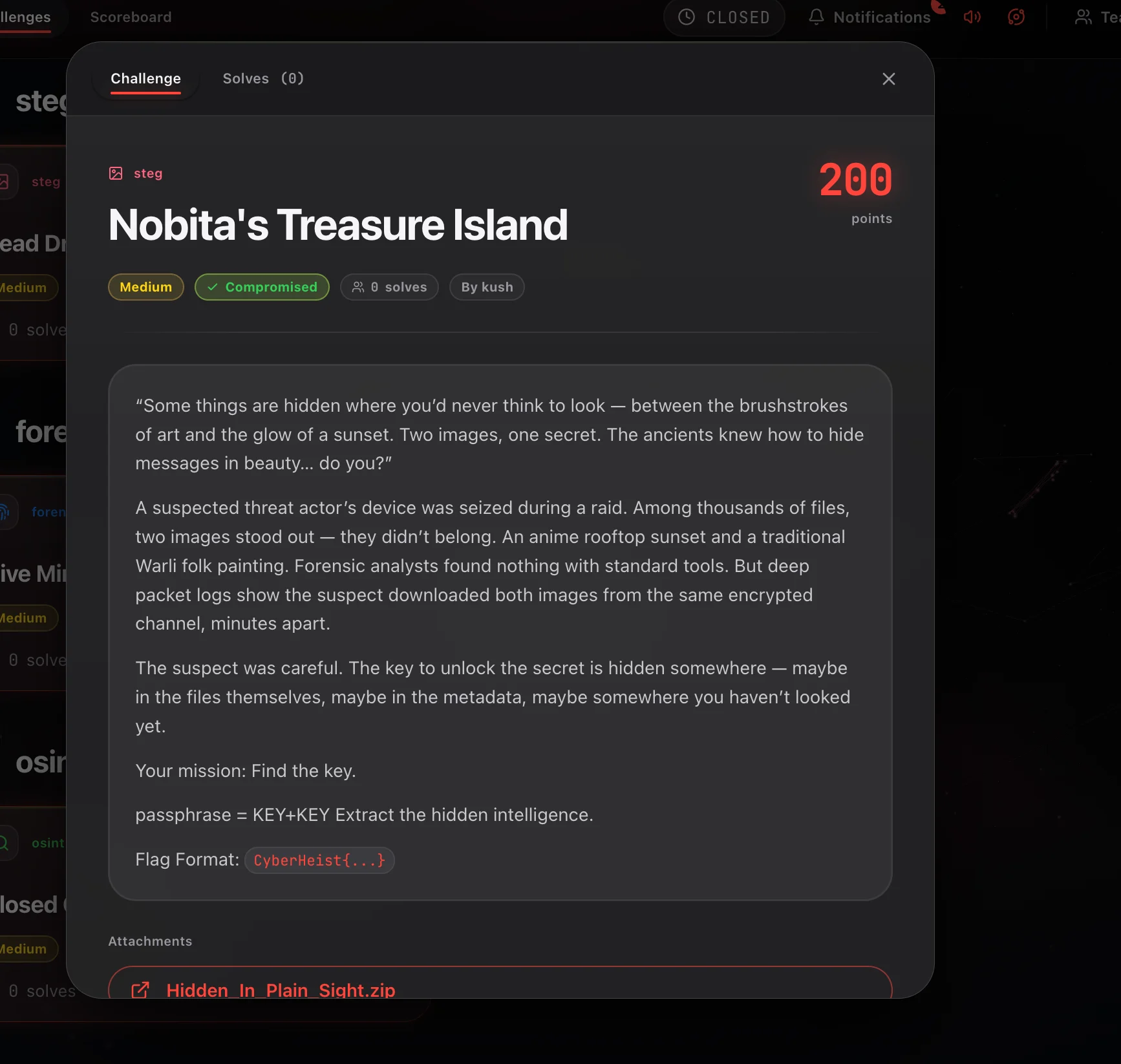
The challenge
The challenge provided two unrelated-looking images: an anime rooftop sunset and a traditional Warli painting. The prompt said that they came from the same encrypted channel and gave the important formula passphrase = KEY+KEY. The goal was to find both key parts, combine them, and extract a flag in the format CyberHeist{...}.
I used Codex with the GPT-5 model during the analysis. I shared the file details and intermediate results with it, then tested the suggested interpretations against the actual images and extraction results.
First look
The files were anime.jpg and warli.jpg. I first checked their metadata, file structure, readable strings, and possible data appended after the normal image endings. These checks did not directly reveal a key or flag. Straightforward pixel and least-significant-bit interpretations also produced noisy or inconsistent results.
A more useful result was that both JPEGs were recognized as Steghide containers. This explained why the images appeared normal and why ordinary metadata checks found nothing. However, Steghide still required the correct passphrase.
The challenge wording suggested that the passphrase was not simply stored as a readable string. The references to the sunset, traditional art, and “the ancients” pointed toward visual symbols inside the pictures.
Finding the way in
The anime image contained a row of birds sitting on wires. Their positions and shapes formed a visual sequence that could be read as:
ABCDJKLM
Some early interpretations treated the birds as ordinary binary marks, but those readings did not produce a meaningful key. Reading the complete arrangement as a sequence of letter-like symbols gave a consistent result instead.
The Warli image contained human figures whose poses resembled the Dancing Men cipher. Comparing the figures with the cipher alphabet produced the second key:
EHTVM
This also fit the prompt’s KEY+KEY clue. Joining the two parts with a literal plus sign gave the final passphrase:
ABCDJKLM+EHTVM
I then used that passphrase with Steghide:
steghide extract -sf anime.jpg -p 'ABCDJKLM+EHTVM'
The extraction succeeded and recovered a short hidden payload. Repeating the extraction against warli.jpg produced the same intelligence, which was a useful check that the visual decoding and passphrase were correct. The payload contained the flag directly rather than another cipher layer.
The flag
The recovered flag, in the required format, was:
CyberHeist{st3gh1dd3n1npl41ns1ght_07e1d9b2fd27}
What I learned
The main lesson was that steganography challenges can use two different hiding layers. Steghide concealed the actual data, while the visible artwork concealed the passphrase needed to reach it. The KEY+KEY instruction was very literal: each image supplied one key, and the plus sign had to remain between them.
Codex with GPT-5 was most helpful for connecting the unusual visual details to known cipher ideas and narrowing down interpretations worth testing. Still, checking the proposed key against both files was important. A plausible-looking decoding was not enough by itself; successful extraction and matching payloads from the two images confirmed the solution.