Dhanurbhanga: The Fractured Invariant
By Team Cryptonite · 2 min read
About the CTF: Pinaka CTF
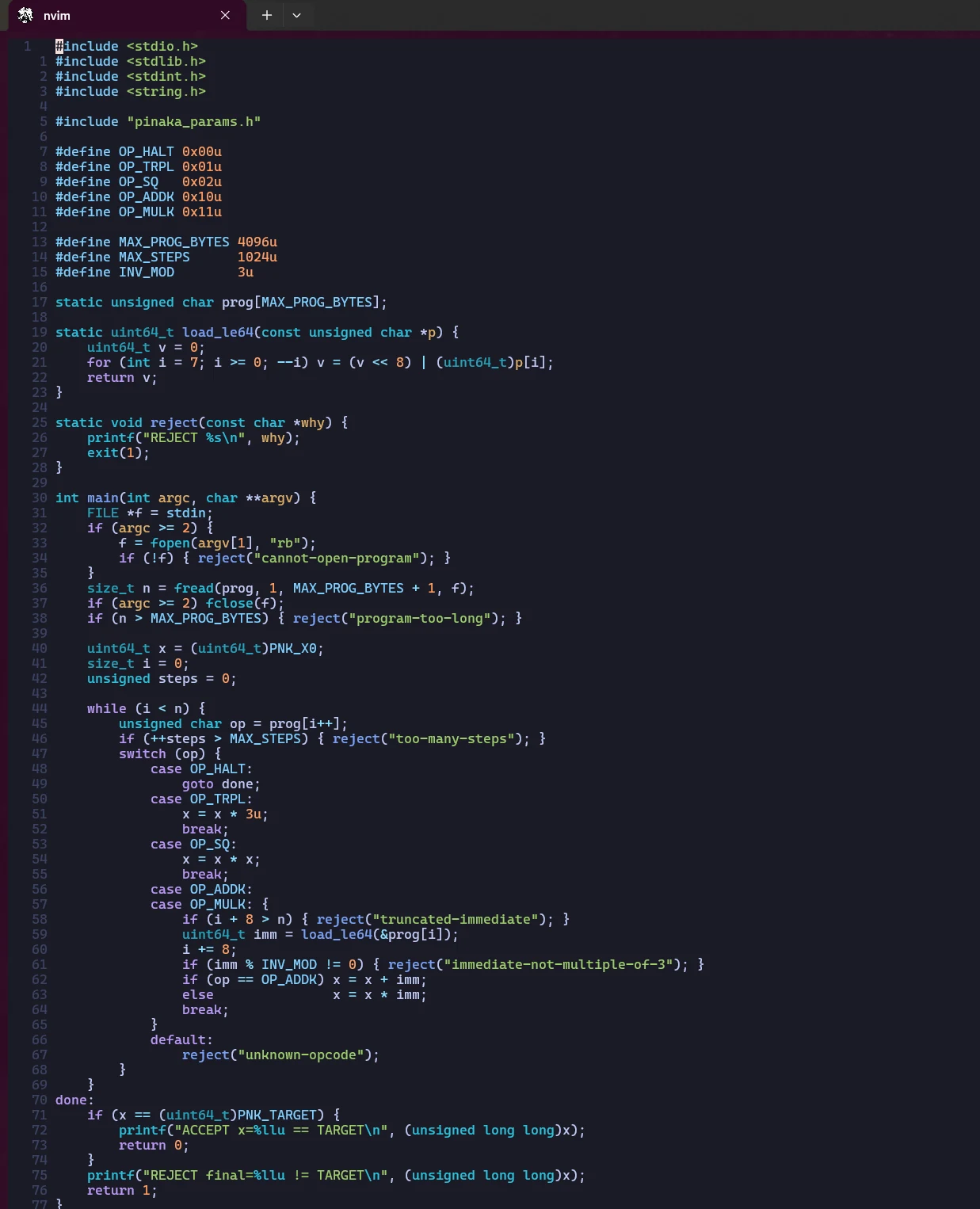
Produce a well-formed Pinaka Tension Machine (PTM) program whose final register equals TARGET = 3205865151537252764. A formal proof says that's impossible over unbounded integers, but the real checker does its…
**Pinaka CTF 2026** · Reverse engineering · Team Cryptonite · All 44 Pinaka write-ups
Category: reverse engineering / logic
Flag: PINAKA{dhanurbhangaasingleuint64wrapshattersshivasunbreakablebow}
Overview
Produce a well-formed Pinaka Tension Machine (PTM) program whose final register equals TARGET = 3205865151537252764. A formal proof says that's impossible over unbounded integers, but the real checker does its arithmetic in uint64.
Files:
pinaka_check.c: the real checkerformal_model.py: Python-bignum model that implements the proof
Analysis
The machine:
- State: one non-negative integer register
x, starting atX0 = 0. - Opcodes:
HALT,TRPL (x3),SQ (xx),ADDK imm (x+imm),MULK imm (x*imm). Immediates are little-endian unsigned 64-bit. - Well-formed means: valid opcodes, complete 8-byte immediates, every
imm % 3 == 0, at most 4096 bytes, at most 1024 steps. - Accept if and only if the program is well-formed and the halting register equals
TARGET.
Why the proof says no. With X0 = 0 and every immediate divisible by 3, "x == 0 (mod 3)" survives every opcode:
TRPL:3x-> preserves it (x3)SQ:x*x-> preserves itADDK:x+immwithimm == 0-> preserves itMULK:x*imm-> preserves it
Every reachable x is divisible by 3, but TARGET == 2 (mod 3), so it's unreachable over Z. formal_model.py implements exactly this and rejects every attempt.
The crack. The proof assumed exact integers, but the checker works mod 2^64, and:
2^64 == 1 (mod 3) (not 0)
Every wraparound subtracts a multiple of 2^64, and because that isn't divisible by 3, it shifts the residue of x mod 3. One overflow is enough to escape the invariant.
Solution
We need a true-integer sum S divisible by 3 (so every immediate is legal) and congruent to TARGET mod 2^64:
S = TARGET + k*2^64 ,   need S  ==  0 (mod 3)
   =>  (TARGET + k)  ==  0 (mod 3)   =>   k  ==  -TARGET  ==  1 (mod 3)
With k = 1:
S = TARGET + 2^64 = 21652609225246804380 (S % 3 == 0, S mod 2^64 == TARGET)
Split S into two ADDK immediates, each below 2^64 and divisible by 3 (2^64 - 1 == 0 mod 3):
10 ffffffffffffffff   ADDK 18446744073709551615   (= 2^64-1,  ==  0 mod 3)
10 9d892eb35e857d2c   ADDK  3205865151537252765    ( ==  0 mod 3)
00                    HALT
Program hex (19 bytes): 10ffffffffffffffff109d892eb35e857d2c00
Under uint64: 0 + (2^64-1) = 2^64-1, then adding 3205865151537252765 overflows once and wraps to exactly TARGET.
Local verification:
formal_model.py:final = 21652609225246804380, REJECT (well-formed but unreachable over Z, as proven)- compiled
pinaka_check.c:ACCEPT x=3205865151537252764 == TARGET

Submission
POST /mithila/dhanurbhanga   {"program":"10ffffffffffffffff109d892eb35e857d2c00"}
 ->  {"status":"bow-broken",
   "checker":"ACCEPT x=3205865151537252764 == TARGET",
   "flag":"PINAKA{dhanurbhanga_a_single_uint64_wrap_shatters_shivas_unbreakable_bow}"}
Notes
- A formal proof is only as sound as its model of the machine. The proof reasoned over Z; the implementation ran over Z/2^64Z.
- Because 2^64 isn't divisible by 3, a single overflow breaks the "
xis always a multiple of 3" invariant.