The Evolution of Blockchain Technology
By Samit Pal · 22 min read
Everything about how blockchain technology evolved
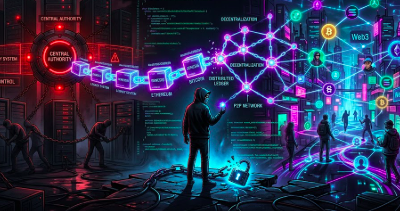
The Evolution of Blockchain technology
Blockchain evolved from a niche experiment to a trillion dollar ecosystem. It didn't just grow, it fundamentally challenged how trust is established in digital systems.
This article explores how blockchain was created, how it evolved, where it stands today, and what the future might hold. Everything in a clear and simple language without being too technical.
Pre-Blockchain Era
Before blockchain, digital systems used to rely heavily on centralized authorities. Banks, governments, and corporations controlled data, transactions, and user access.
For example, Banking system. People put there money in bank, bank handles everything and people lacks the direct authority.
2008: The Birth of Blockchain
An anonymous man, named Satoshi Nakamoto introduced a white paper that would redefine the way people see trust in digital systems and authority.
He proposed the idea of secure, transparent and sovereign digital currency "Bitcoin". It was a solution to the double spending problem, enabling peer to peer transaction without a central authority.
At its core was blockchain:
A decentralized, immutable ledger maintained by a network of participants rather than a single entity.
For the first time, trust was shifted from institutions to mathematics and consensus.
Blockchain 1.0: The Era of Digital Currency
This was the first phase of blockchain technology in the public hands, it was focused almost entirely on financial transaction ( Yeah your Bitcoin started here )
Bitcoin demonstrated that,
-> Money could be transferred globally without needing banks
-> Fully secure and transparent transactions
-> No centralized system, instead network of nodes running everything.
Until here blockchain systems were limited. They were designed for specific use cases.
Blockchain 2.0: The Rise Of Smart Contracts
It all started with "Ethereum". A kind of blockchain that expanded old blockchain's capabilities by introducing smart contracts.
( Smart contracts are self executing programs that run on blockchain )
This transformed blockchain from a payment system into a programmable platform, enabling developers to build decentralized applications (dApps). Now people could build applications on-chain with full transparency and security.
Blockchain 3.0: The Expansion into Ecosystem
As the technology matured, blockchain moved beyond finance. More and more applications were building on chain. A lot of different solutions such as layer 2s, different protocols and side chains came into existence to achieve the maximum potential of blockchain.
DeFi, NFTs, DAOs, Memecoins, On-chain gaming and many more user interactive components were built. Now blockchain evolved into an ecosystem where users could interact, transact, and govern without intermediaries.
Blockchain Today: Scaling Toward Mass Adoption
Despite its potential, blockchain has face significant challenges, particularly scalability and usability issues.
To address these, the ecosystem has introduced major innovations such as,
-> Layer 2 scaling solutions
-> Improvement in consensus mechanisms
-> Interoperability among different chains
Today blockchain is being explored by many industries,
-> Supply chain tracking
-> Digital Identity Systems
-> Gaming
-> Voting Systems
and many more.
Major institutions, startups, and governments are actively investing in blockchain, signaling a shift from experimentation to early stage adoption at scale.
The Future: Evolution or Decline?
In current situation, blockchain stands at a critical intersection.
On one hand, its integration with emerging technologies such AI and decentralized identity systems could redefine how the internet works itself ( that's what we call web3 )
On the other hand, regulatory pressure, reducing gas fee and technical limitations are real challenges.
Let's discuss the possible future of blockchain,
-> Mass Adoption: Blockchain becomes invisible infrastructure powering finance, identity, and digital ownership.
-> Selective adoption: Used in specific industries but not universally dominant
-> Decline: Fails to overcome scalability and usability challenges
The outcome will depend not just on technology, but on trust, regulation, and real-world utility.